

Candidness Of Human Emotion
Artworks
- Artwork 1.) L’Absinthe, Edgar Degas, 1876, Oil on Canvas (1876) — L’Absinthe aims to express two plainly miserable people; a man staring off into the distance, and a woman gazing forward. The use of colorful reds and yellows highlights this further by utilizing contrast; warm colors that would usually point to a more positive or contented feeling instead serve to further highlight how miserable the two figures in the painting are. While impressive in its execution, this prominent display of sorrow was a factor that, when it was created in 1876, led to a notably negative reception for the controversy that came with painting such a downcast scene.The feeling portrayed here is a somber one, a sense of hopelessness. Both of the figures look away from the viewer, as if they are trying to find some kind of solution to the problems they face, but find that no answer comes to mind. They appear lost, without any semblance of an answer for their troubles. Edgar Degas conveys a feeling of notable emotional depth, the kind of sadness that comes easily. It’s a moment that seems like it will linger, long after it has ended.
- Artwork 2.) Little Girl In A Blue ArmChair, Mary Cassatt, 1878, Oil on Canvas (1878) — This is a room with four blue armchairs, two further away from the viewer, and two very close. The further armchairs are empty, and the closer ones hold a small brown dog which appears to be sleeping, and a young girl wearing a white, green, and blue dress with matching socks and a ribbon. The girl has a thoughtful, slightly frustrated look on her face, and is slouched on the armchair in an informal manner. This piece is made up primarily of different blues, bright and vibrant. The almost random usage of reds, greens, pale oranges, and cream yellows against the teal blues of the armchairs imply a more detailed pattern than what is seen, creating a backdrop that allows for more focus on the girl slouched on the front armchair. Also notable is the way that the style of painting changes throughout the painting; the messier chairs with visible brushstrokes contrasting the more blended strokes used to paint the girl, once again pointing the viewer’s eyes towards her. Cassat was painting the child of a friend here, with the intent of showing the complex emotions a child may feel in day-to-day life, in this case the frustration and annoyance of the rules and behaviors that a child would have to follow constantly. The artist here both makes a point of accurately portraying a child’s view of a strict world, and pokes fun at the girl’s reaction, a scene that feels as though it could be a daily occurrence.
- Artwork 3.) The Floor Scrapers, Gustave Caillebotte, 1875, Oil on Canvas (1875) — This work portrays three men in a room with no furniture, all three of them are dressed the same, wearing only shoes and pants, and all three of them have pale skin and short brown hair. The three are crouched on the floor throughout the room, using tools to scrape up the wooden flooring; wooden shavings piling up around them. On the far wall is what appears to be an ornate window, which is where the light in the room is coming from. Along the back wall is also what looks like bags, and closer to the front a bottle and a half-full cup stand on the floor. This piece utilizes repetition, in that all three figures shown appear in the same clothes, are kneeled in the same position, and are all working towards completing the same goal. The main idea behind this work is day-to-day labor, upkeep that is necessary. This scene portrays everyday labor, creating an image of the less showy parts of life. This style of painting which focused more on realism, particularly in anatomical accuracy and lighting, was popular at the time. There’s no glorification of this job, rather a picture meant to show the honest truth of the chores an average person would have faced. Despite the purposefully dull tone, the work still has a sense of life and movement to it, conveying progress and a promise of the pride of a job well done.
- Artwork 4.) The Cradle, Berthe Morisot, 1872, Oil on Canvas (1872) — This painting depicts a woman wearing a black dress, with her hair tied back behind her head. She leans forwards, over a cradle covered with sheer white curtains, peering at a sleeping baby inside the cradle. The woman is supported partially by the cradle, resting her arms on it. The expression on the woman’s face is neutral, paying attention only to the child in the cradle. This piece uses contrast to display the focal points, highlighting the woman in dark clothing, and the baby surrounded by pale fabrics. Lighter tones are used to emphasize the transparency of the curtain draped above the cradle, allowing for the child to still be visible behind it. The curtain also frames the woman’s face, further accentuating her as a central figure within the painting. This work depicts Morisot’s sister and her sister’s daughter, in an image of motherhood. It’s clear from the focus Morisot’s sister gives to her child that the bond they have is great, and that this mother has a lot of love for her child. This work is a picture of familial love, and a call to the care and attention seen in relationships such as this. As is seen in the painting, this mother devotes a lot of attention to her child, displaying a bond that will surely shape both of the subjects in the painting significantly. This scene captures a moment in time that is missed long after it ends.
- Artwork 5.) Luncheon Of The Boating Party, Pierre-Auguste Renoir, 1881, Oil on Canvas (1881) — This work shows many people, both standing and sitting, speaking to one another in a lively manner. They appear in several different states of dress, some more formal and others looking more casual. Near the front of the painting, there is a table with a white tablecloth, on it several bottles, fruits, and dishes. Around the table are wooden chairs. On one side of the table a girl in a black and red dress sits, playing with a small brown dog, and a man stands next to her looking towards the people talking in the background. On the other side of a table, a man sits casually, speaking with a woman in a blue dress and a man in a cream-colored top, who is leaning above the woman. This work has an overarching warm tone in the coloring, using cream-whites, yellows, and oranges all throughout the painting. The warmer coloring is emphasized by the greens used in the background, which also highlights the silhouettes of the figures within the painting. This piece does not have obvious brushstrokes, instead making a point of using heavy detail, most notably in the fabrics of the clothing worn by the subjects. The people in the work are Renoir’s friends, as well as the woman who would be his future wife, seen playing with a dog in the foreground. Notably, this same woman was not in the original scene; instead painted in at a later time to replace a different woman. Given that the subject matter is the artist’s friends, and the coloring and posing point to a positive tone, it's clear that the emotion felt here is contentness; the feeling of being surrounded by well-liked companions, in a setting that is comfortable. This piece conveys a memory that’s meant to be looked back at fondly, depicting a scene that would undoubtedly bring joy to the artist.
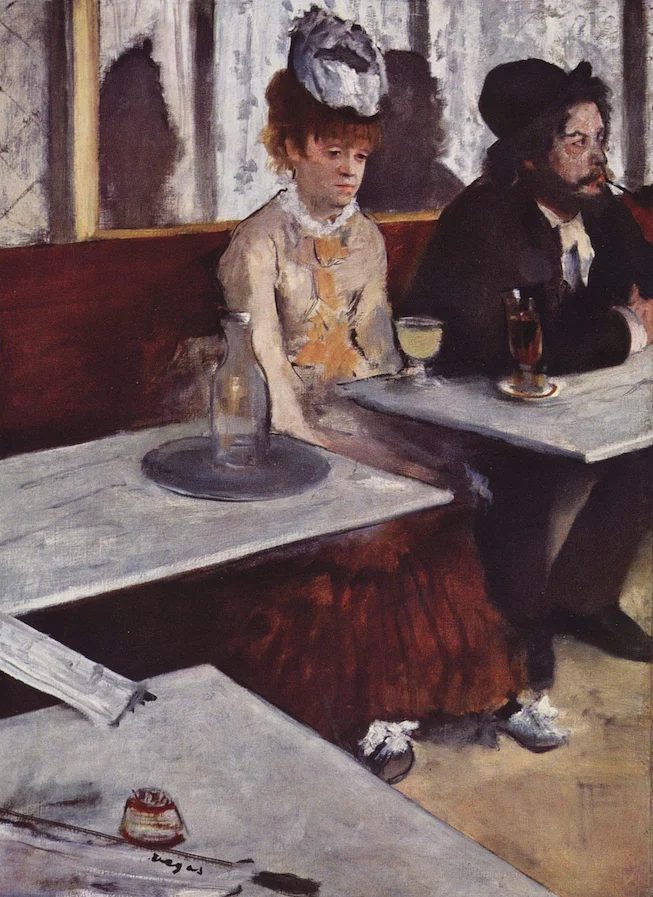
Artwork 1.) L’Absinthe, Edgar Degas, 1876, Oil on Canvas
1876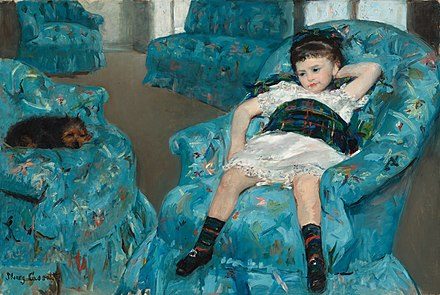
Artwork 2.) Little Girl In A Blue ArmChair, Mary Cassatt, 1878, Oil on Canvas
1878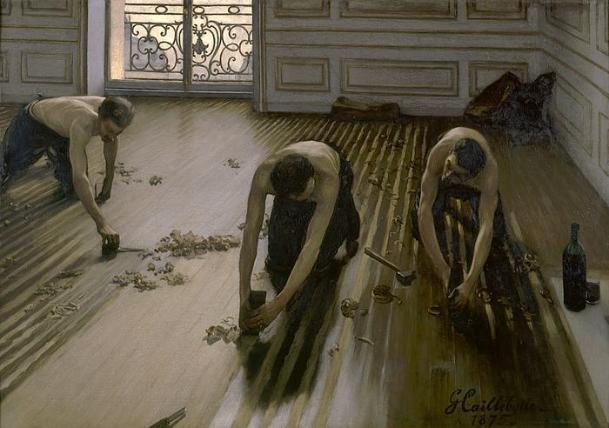
Artwork 3.) The Floor Scrapers, Gustave Caillebotte, 1875, Oil on Canvas
1875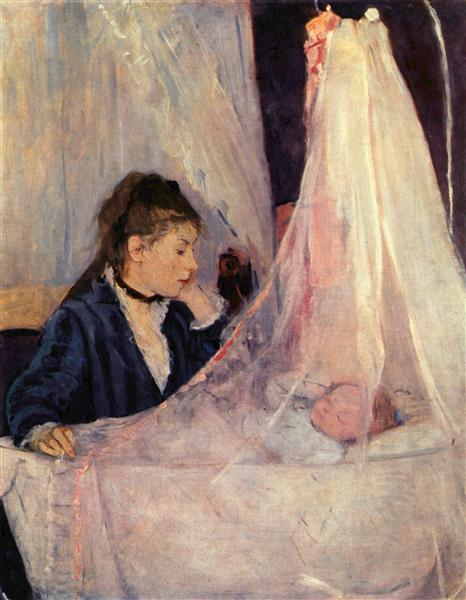
Artwork 4.) The Cradle, Berthe Morisot, 1872, Oil on Canvas
1872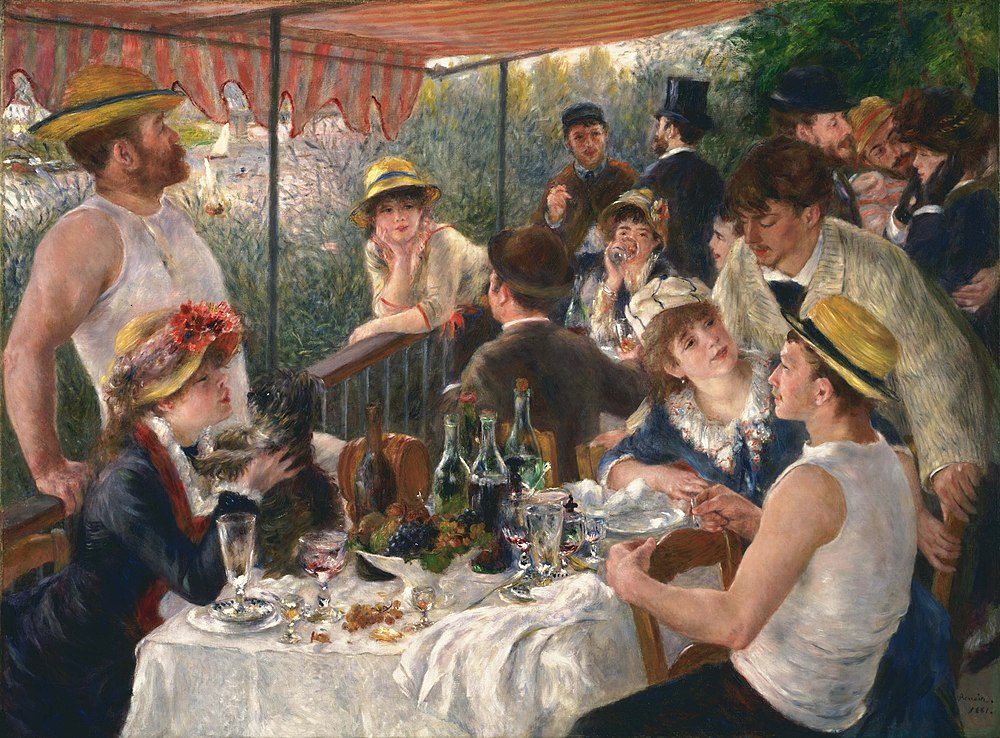
Artwork 5.) Luncheon Of The Boating Party, Pierre-Auguste Renoir, 1881, Oil on Canvas
1881Immersive Experience
Walk through this gallery in 3D
Step inside a virtual gallery space. Walk up to each artwork. See them as they were meant to be seen.
React to this gallery
Guestbook
Sign in to leave a comment.
Loading…