Skin, Bone and Time: Colonial Violence and Reflection

6 artworks 45 views Walk Through in 3D

Artworks

  • Skin, Bones, and Time: Colonial Violence and Reflection (2026) — Amongst Mexican People bears a long and very complex history enveloped in warfare, revolution, and the carrying of their traditions. The vision today of Mexican People is carried forward by the lasting generations of those events and the very diligence that made survival of many large scale events possible. Most importantly to the topic at hand though is the epicenter of such events that caused the turmoil in the first place: colonial violence carried through time. Bearing movement from the Aztec Empire to the spreading of culture throughout the Americas, colonial violence has been at some of the root core of issues that plague Mexican history and its people. Whether by Spanish, French or Americans, Mexico and the people that travel within and from it, having faced a long legacy of the collection of traumas that stemmed from those original perpetuations. Cortes himself reflects on his time in the first perpetuation of many that would lead to the eventual collapse of the Aztec Empire by stating as such, "If he (Aztec Emperor Moctezuma ll) was under my control, all the other countries that were subject to him would be more easily brought to the knowledge and service of your Majesty”. Skin, Bone, and Time: Colonial Violence and Reflection as an exhibit is not only exploring the sorrows and triumphs that is reflected in the art pieces on display, but also a reflection of what has been passed down to the views of the people, artists or not. What is also to be said, is what individuals can take from their own experiences and pass onto those who may continue to either perpetuate colonial violence, or be affected by it even until today. In these instances of artworks, we will see a glimpse of the fetishization of native brown bodies and the outer shell of a beginning and potential continuous future from James Luna. An original artwork from one of the colonial forces at hand from an unknown Spanish artist, and the colonizer viewpoint within history. We will also see personal views put forward on colonial aftermaths with artworks from José Clemente Orozco and his brutal perspective on Mexico’s history. From Frida Kahlo’s work, a connection between what it means to morph into both Mexican and American heritage, and losing those native roots to a colonial body. Lastly we will reflect on triumph amongst colonial spaces in artwork from Judy Baca, with looking to a future of creative freedom and denial of past violences. The ties that bind these artworks are their connections in colonial violence of past, present and hopeful future, and are all connected from Luna, Unknown, Orozco, Kahlo, and Baca (in order), by both their actual places in a timeline order and their meetings from original colonial sin, to many years later aftereffects.
  • Artifact Piece by James Luna, 1987, Performance, Medium: Art, Wood, Metal and Plexiglass Vitrines, Sand, Text Panels, and Artist Possessions (1987) — James Luna gives a vulnerable and honest portrait of how he views his own culture through the lens of others. Within this performance art he gives a personal experience on what he thinks those at museums and their viewers really take in by displaying Native American artifacts. In this he becomes a living “dead” artifact with his work, and gives the viewer a chance of objectification of his living person. With his almost naked body and dead lay, he reflects back to the viewers what they really should take in any Native Americans artifacts displayed in other places, and leaves a strong image for those willing to be vulnerable alongside him. The piece made into a real life painting creates a focal point that draws in all that view, making his body the centered piece within a live image, the signs on display further incentivizing this by describing him as just another image. All context comes with him by displaying his own heritage, and becoming the fetish of artifacts he asks the viewers to now look down upon within his piece. James Luna becomes the physical manifestation of a body tied into time, and presents as a signature piece within this exhibit by extension of being skin and bone himself.
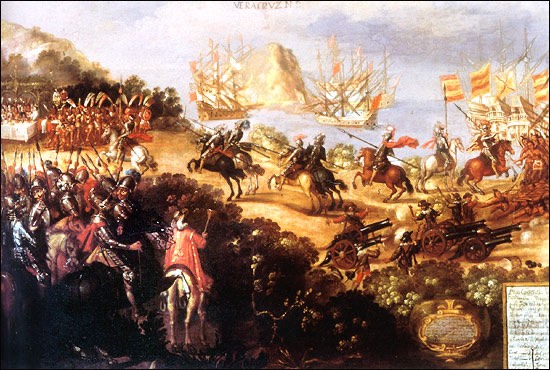
  • The Arrival of Cortes in Veracruz and the Reception by Moctezuma's Ambassadors by Unknown, second half of 17th century, oil on Canvas 120 x 200 cm (47.2 x 78.7 in) (1700) — The painting at hand is of much significance in the history of Mexicans and their indigenous ancestors, by displaying a violent first contact of many among them and the Conquistadors. Carrying both a conflict and professional meeting, this image leaves little to be imagined in the raw display of human negotiation. The display is a strong if also dishonest one that makes a point of holding the Aztecs as savages and soldiers as honorable and heroic. The brighter colors for the soldiers in arms carries a sense of enlightenment, which is contrasted by the Aztecs who carry no significant facial features or uniform look to them. Along with fluid motion of the painting that carries you across to the focal point of the soldiers and their meeting, the piece hides darker shadows and palette for those in the shadows waiting. The depiction is all but a harrowing sight in the context of the history, and looks to reshape what really happened at the beginning of the end for the Aztec Empire. Colonial ties in the Americas extend back to this furthest point in the first of many meetings, and reflect back upon the viewers and this exhibit the primary example of colonial violence.
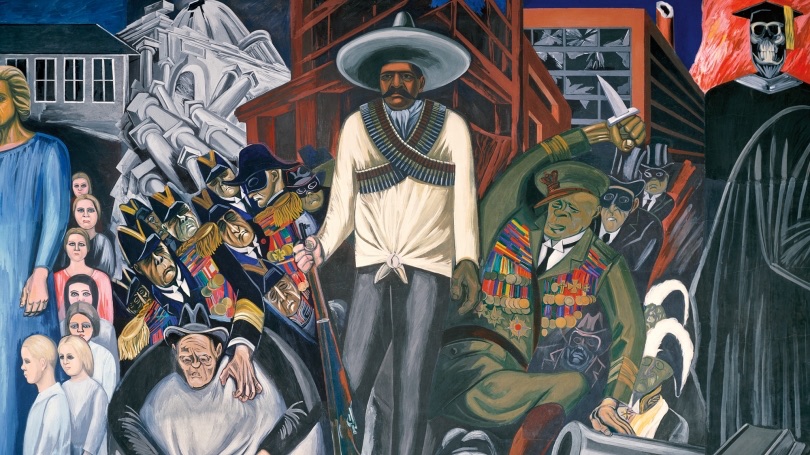
  • The Epic of American Civilization by José Clemente Orozco, 1932-1934, Mural, Fresco Painting, 3,200 ft (1934) — This mural from José Clemente Orozco, is a grand sweeping image of what a dialogue on true history may look like from a native perspective. Placed within perspective are school institutions for Mexican children,revolutionary figures such as Emiliano Zapata, and skeletal beings in scholarly wear. The fuller image shows the Conquistadors, the movements of civilizations and the mechanization of the Americas. The rougher angles and brutal colors put in place a more violent and less nice outlook on what Colonialism brought to the Mexican People. It also tells this story through a segmenting of each historical period within its “timeline”, and portrays itself almost like a large scale storybook, moving viewers along it left to right. As a whole, it makes a horrific impression of American and Mexican history, and never is shy of that fact. Contextually it is both a display of colonial violence and the history it leads into, but is also José Clemente Orozco's outlook carried by his own personal connection to Mexican heritage and ancestry. It is his own critique of the colonial powers of Spain, France and the US and exemplifies the exhibit as a whole.
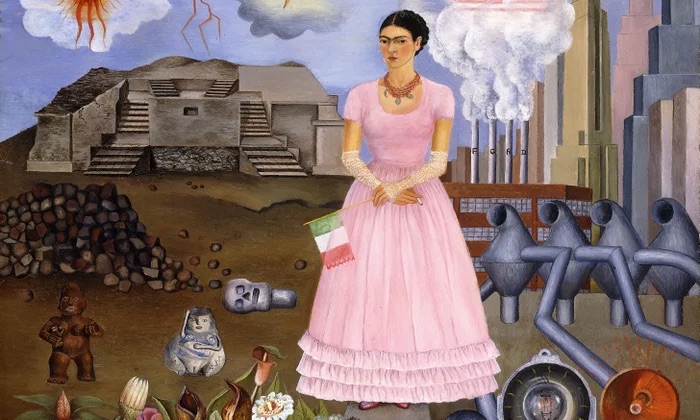
  • Self Portrait Along the Borderline Between Mexico and the United States by Frida Kahlo, 1932, oil on metal, 31 x 35 cm (12.2 x 13.8 inches) (1932) — With the apparent divide of identity, Frida Kahlo calls to be viewed as an extension of both her cultures, and as just an individual who suffers in finding herself in the chaos of dual citizenship. Carrying displays of American and Mexican culture in her body and actual flags in her hand, she creates an image of divide that is only brought together by her own being, with a background of smog and grey to fill many parts of the canvas. The dulled colors of both the American and Mexican side are also brought together by Frida herself by making her the conceptual tie between in the contrasting pink. This self portrait also brings ties to understanding of old world cultural aspects with temples from the Aztec Empire and modern architecture, being also surrounded by mechanized and natural rooting at Kahlo’s feet. Frida sees herself as the culmination of a Mexican identity brought into new aspects within itself, as at the time, she had been in movement between the two cultures, but longed to return to her people, only held back by her husband, her new found name as Carmen Rivera. This is one of the most reflective of her pieces, carrying the burden of almost forced internal colonization, and is a cry towards viewers to be more than a doll or statue on display.
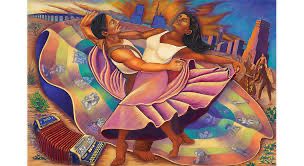
  • Danza de la Tierra by Judy Baca, 2008, Acrylic on Wood, 8 x 24 ft (2026) — The piece as a whole is a method of connection to Latino history, in the most positive and reflective manner of art. The vibrancy of colors, display of action and backdrop of location all build a story of positive aspects and development, while simultaneously bearing two dancers, a man and woman of Mexican descent, already in motion of said vibrant dance. The tilted and skewed perspective of the image, gives extra motion to the image and its display, while also distorting all but the centered dancers, making the rest of the image out of focus. The out of focus aspects are still important as a whole, with displays of prominent Mexican figures on the tarp, and the people amongst the backdrop being priests and creatures. Amongst the background is a place of sour work in Mexican history as Texas carries a negative reaction with ties to colonialism and its violence. This piece displays reclamation and proudness in a culture built to the modern times. The creator looked to tie into both the limited history of dance in Texas history, and the beauty of it all as a way of truest expression of Mexican pride for the school of dance it proudly displays in.
Skin, Bones, and Time: Colonial Violence and Reflection

Skin, Bones, and Time: Colonial Violence and Reflection

2026
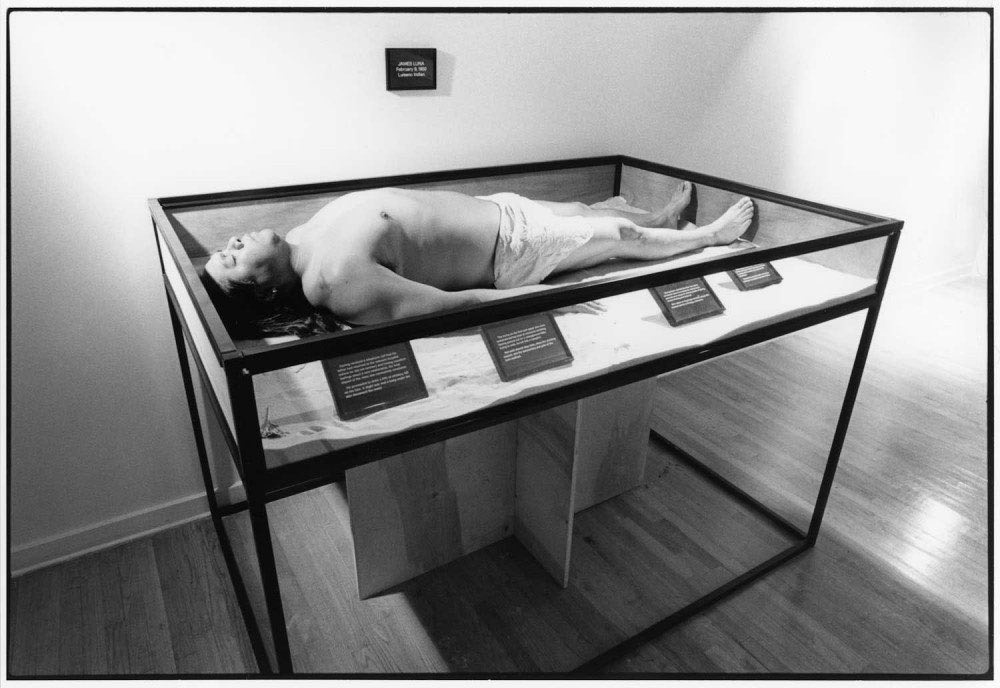
Artifact Piece by James Luna, 1987, Performance, Medium: Art, Wood, Metal and Plexiglass Vitrines, Sand, Text Panels, and Artist Possessions

Artifact Piece by James Luna, 1987, Performance, Medium: Art, Wood, Metal and Plexiglass Vitrines, Sand, Text Panels, and Artist Possessions

1987
The Arrival of Cortes in Veracruz and the Reception by Moctezuma's Ambassadors by Unknown, second half of 17th century, oil on Canvas 120 x 200 cm (47.2 x 78.7 in)

The Arrival of Cortes in Veracruz and the Reception by Moctezuma's Ambassadors by Unknown, second half of 17th century, oil on Canvas 120 x 200 cm (47.2 x 78.7 in)

1700
The Epic of American Civilization by José Clemente Orozco, 1932-1934, Mural, Fresco Painting, 3,200 ft

The Epic of American Civilization by José Clemente Orozco, 1932-1934, Mural, Fresco Painting, 3,200 ft

1934
Self Portrait Along the Borderline Between Mexico and the United States by Frida Kahlo, 1932, oil on metal, 31 x 35 cm (12.2 x 13.8 inches)

Self Portrait Along the Borderline Between Mexico and the United States by Frida Kahlo, 1932, oil on metal, 31 x 35 cm (12.2 x 13.8 inches)

1932
Danza de la Tierra by Judy Baca, 2008, Acrylic on Wood, 8 x 24 ft

Danza de la Tierra by Judy Baca, 2008, Acrylic on Wood, 8 x 24 ft

2026

Immersive Experience

Walk through this gallery in 3D

Step inside a virtual gallery space. Walk up to each artwork. See them as they were meant to be seen.

Experience in 3D

React to this gallery

Guestbook

Sign in to leave a comment.

Loading…