The Contemporary Race: challenging disappearance through modernity

5 artworks 10 views Walk Through in 3D

Artworks

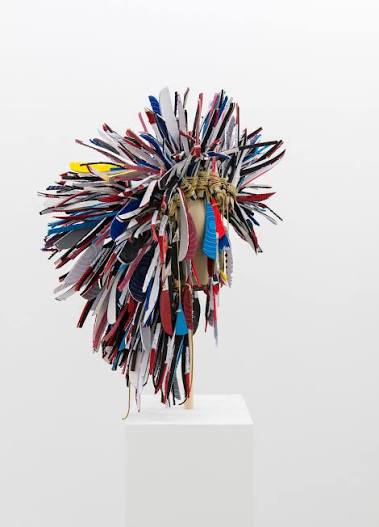
  • Brian Jungen - "Warrior 2" (2017): Nike Air Jor­dans, hide glue, deerskin, 77 x 29 x 24 in. (196 x 74 x 61 cm) (2017) — "Warrior 2" (2018) by Brian Jungen is a life-sized sculpture of a Native American war bonnet composed of cross-sections of Nike Air Jordans, attached via hide glue and deerskin. Sneaker sections shaped like feathers fill the headdress in striking, traditional colors, resembling a lion’s mane and asserting a deep sense of strength and authority. Arranged diagonally like sun rays to point away from the face, the “feathers” gesture towards its wearer and signal to the viewer that the person adorning the bonnet is of immense significance, likely the chief of the tribe. By constructing the piece of scrapped Air Jordans, but connecting them with traditional adhesive in the shape of a war bonnet, Jungen challenges the Western, colonial-based assumption that Native individuals are detached from modern society, or fading out of relevance; this sculpture proves that Native individuals do not have to betray their cultural roots in order to be prominent in the Western world. Built from literal pieces, "Warrior 2" (2018) tells a story of a phoenix race rising from the imperialistic ashes, culminating in a contemporary-traditional blend that demonstrates a deep connection to one’s culture, as well as an acceptance towards merging with the Western world. It takes advantage of a consumer-driven world of obsessive taking, buying, and collecting to give back with a handmade, personal message of Native resilience, and what the sharing of cultures, rather than the exclusion of them, can do.
  • Tom Farris - "Custer's Last Hand" (2024): decommissioned and repurposed slot machine, Dimensions 53 × 26 × 20 inches (134.62 × 66.04 × 50.8 cm) (2024) — “Custer’s Last Hand” (2024) by Tom Farris is a repurposed 1970s slot machine that challenges the Westernized understanding of the U.S. vs. Native American “Battle of the Little Bighorn” (1876), as well as reflects on the necessity of compensation for the horrifically violent history that Americans have towards Indigenous folks. The life-sized machine includes titles (with an Indigenous arrow piercing the big “C” in “Custer’s), a patterns key (such as three blue sevens winning “Cultural Preservation”), a list of accepted currency (from bills to land back), and a dish at the bottom to receive your prize (currently holding shells). 3-D buttons and a real wood arm on the side make this machine appear to be working, adding another layer of meaning as the piece directly asks its audience to play for themselves. Receiving land back or sovereignty whether you win or lose (as written on the machine) implies that the audience for this piece is mixed; the ultimate demand for recompense to Native Americans for their treatment by colonizers is necessary regardless of the viewer’s identity or background. “Custer’s Last Hand” (2024) reflects on a relevant issue that continues to weigh on our society to this day—is there any way our country can ever make up for how it treated the people native to this land, and in the meantime, what can we do to extend compassion to those we’ve hurt while eliminating ignorance on the topic as a whole?
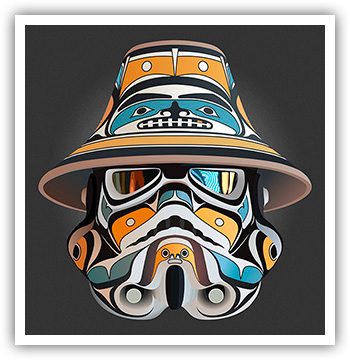
  • Andy Everson - "Northern Warrior" (2015): acrylic-painted Star Wars stormtrooper helmet replica (unclear origin), with painted maple wood conical hat — "Northern Warrior" (2015) by Andy Everson is a reworked Star Wars stormtrooper helmet that has been illustrated with flowing, Western-Coast Native designs and adorned with a traditional warrior’s conical hat. The patterns, in black, white, and striking amber and teal, illustrate the Kwakwaka’wakw crest of the sisiyutł (the double-headed serpent) on the hat, linking the piece back to his Indigenous Canadian roots and his warrior ancestors. The symbol, representing the presence of both good and equal, is juxtaposed by a human-esque face that calls the viewer to choose where they stand. Selecting a stormtrooper helmet as the canvas draws in Everson’s love of the Star Wars franchise, as well as his deep admiration and pride for his Kwakwaka’wakw heritage; it also symbolizes the way that the Native fight has changed over time—from physical clashes to perpetually fighting back against a world that constantly excludes Indigenous people. Everson’s artwork tells a story of Indigenous resistance across all time, and beautifully blends past and future to show that the contemporary world is not exclusive to white, Western, colonist society—Native people are present, and here to stay.
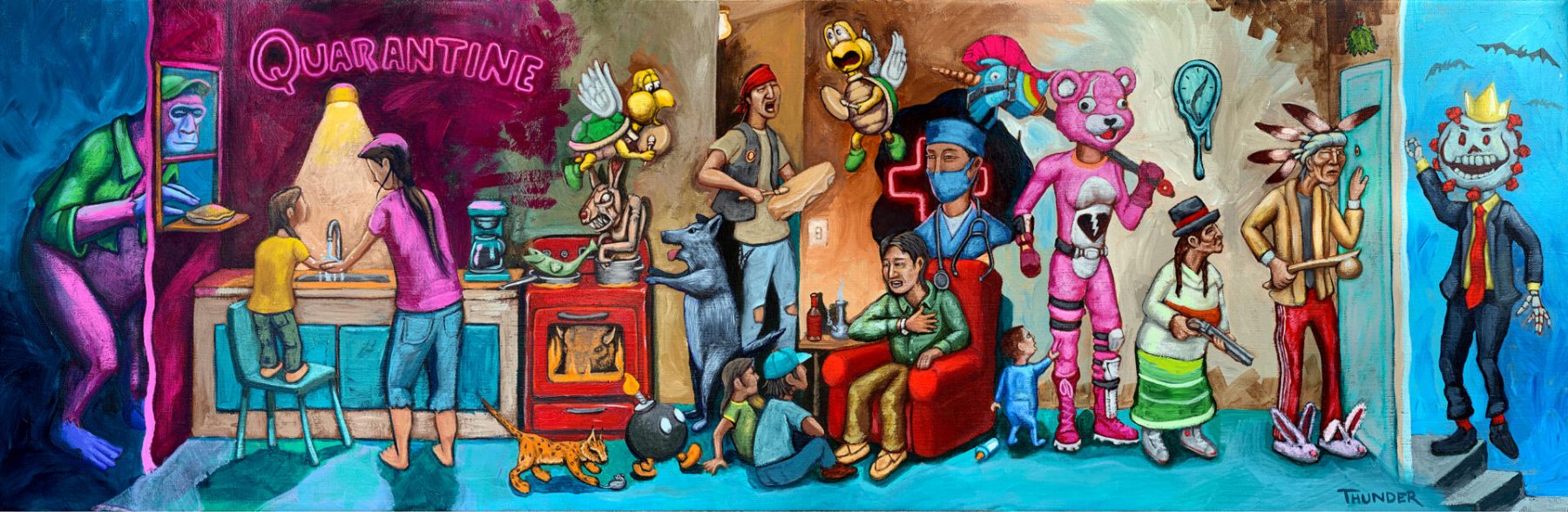
  • Jonathan Thunder - "Quarantine at Gramma's House" (2020): acrylic on canvas — "Quarantine at Gramma’s House" (2020), by Jonathan Thunder, captures a moment in time during the COVID-19 pandemic of an extended Indigenous family living together in quarantine. As if looking into a dollhouse, the viewer sees a family inside a home while a personification of COVID-19 knocks on the front door. A sense of chaos is created with the variety of smaller scenes within the image, such as a mother and child washing their hands, popular video game characters wandering the room, and two weapon-wielding Indigenous characters wielding weapons near the front door. Near the center of the canvas sits a man who is narrating the undertakings of medical first responders, breaking up the havoc with a moment of genuine seriousness. Traditional Native American and contemporary elements weave together in this painting, such as with Indigenous frame drums being played by two Koopa Troopas (from the Mario franchise); The lack of depth cramps the family together and represents how their lives are now forced to suddenly overlap. A highly saturated color palette makes the scene feel light and humorous, contrasting against the darkness of the context. This painting shows that through the conflicts and the chaos of quarantine, there is a sense of harmony in being all together. The presence of ancient and modern elements also illustrates to the viewer how Indigenous families were experiencing this pandemic just like any other residential family—playing games, telling stories, and adjusting to the new kinds of messiness in their lives.
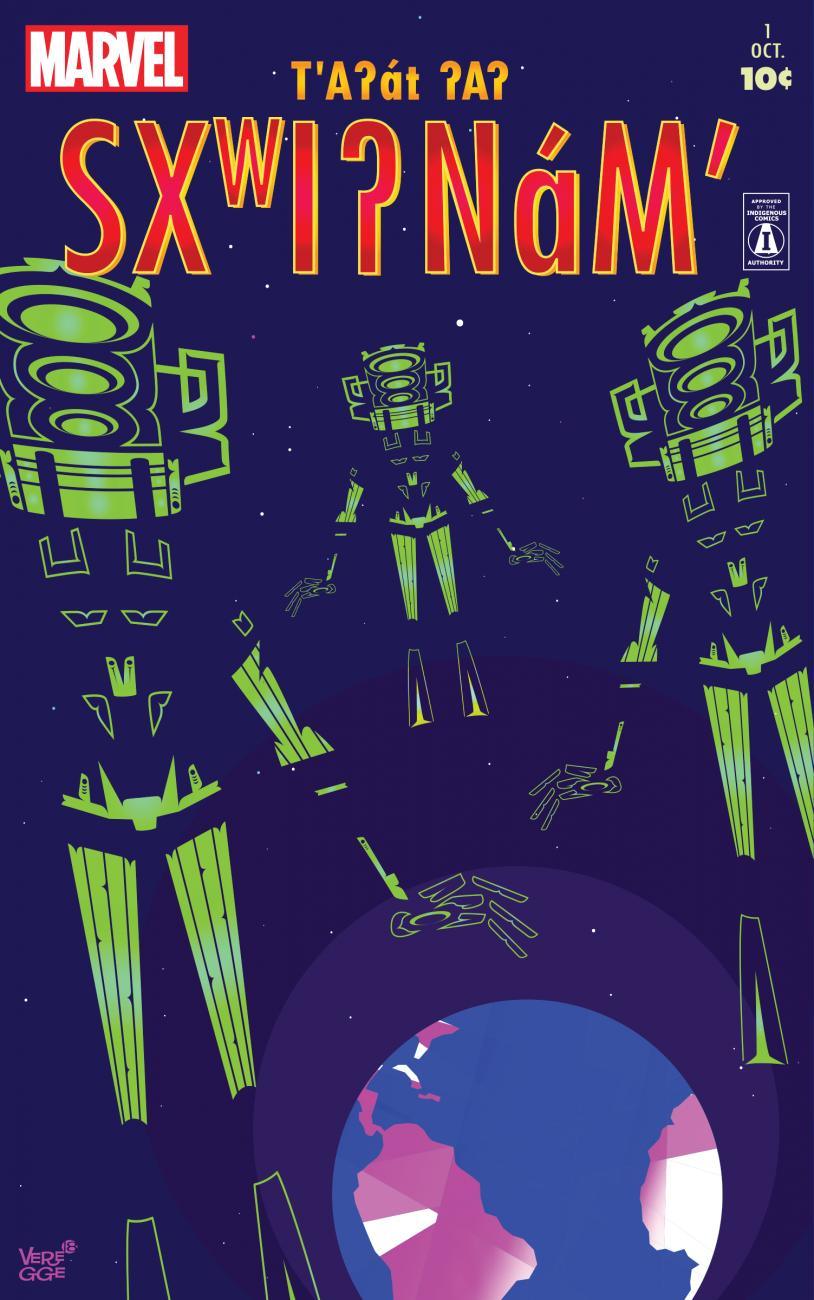
  • Jefferey Veregge - "Of Gods and Heroes" (2018): made in Adobe Illustrator, part of a print on two 50 ft murals — This section of Jeffrey Veregge’s “Of Gods and Heroes” (2018) mural exhibit resembles a Marvel comic book cover in composition, while integrating elements of Native American design and style. Three neon green Celestials (cosmic deities from the Marvel universe) composed of detached Salish patterns levitate in space above a discolored Earth. The Marvel logo and stamp of approval from the Indigenous Comics Authority (ICA) border the top section of the artwork, juxtaposed with assertive scarlet, gold, and slightly extruded text in the Native language of Veregge’s tribe titling the piece nearby. In classic comic book cover style, this artwork makes us anticipate what the Celestials may do next, or have us question what they have already done. Indigenous patterns, text, and the ICA’s stamp reshape a classically American concept in a way that does not overshadow or ignore pop culture, but improves upon it by opening the audience to reach a group vastly underrepresented in Western media. The message and clear love of comic book culture evident in the piece is only further honored with Veregge’s creative decisions, faithfully recreating a story that now allows for more connection across “contrasting” cultures. Veregge proves that this divergence does not have to separate people, but rather can lead to more ambitious, imaginative works of art when the beauty in each culture can be shared. This artwork stamps Native American culture into the comic world, solidifying its place and echoing superheroes’ mantra of, “Anyone can be a hero.”
Brian Jungen - "Warrior 2" (2017): Nike Air Jor­dans, hide glue, deerskin, 77 x 29 x 24 in. (196 x 74 x 61 cm)

Brian Jungen - "Warrior 2" (2017): Nike Air Jor­dans, hide glue, deerskin, 77 x 29 x 24 in. (196 x 74 x 61 cm)

2017
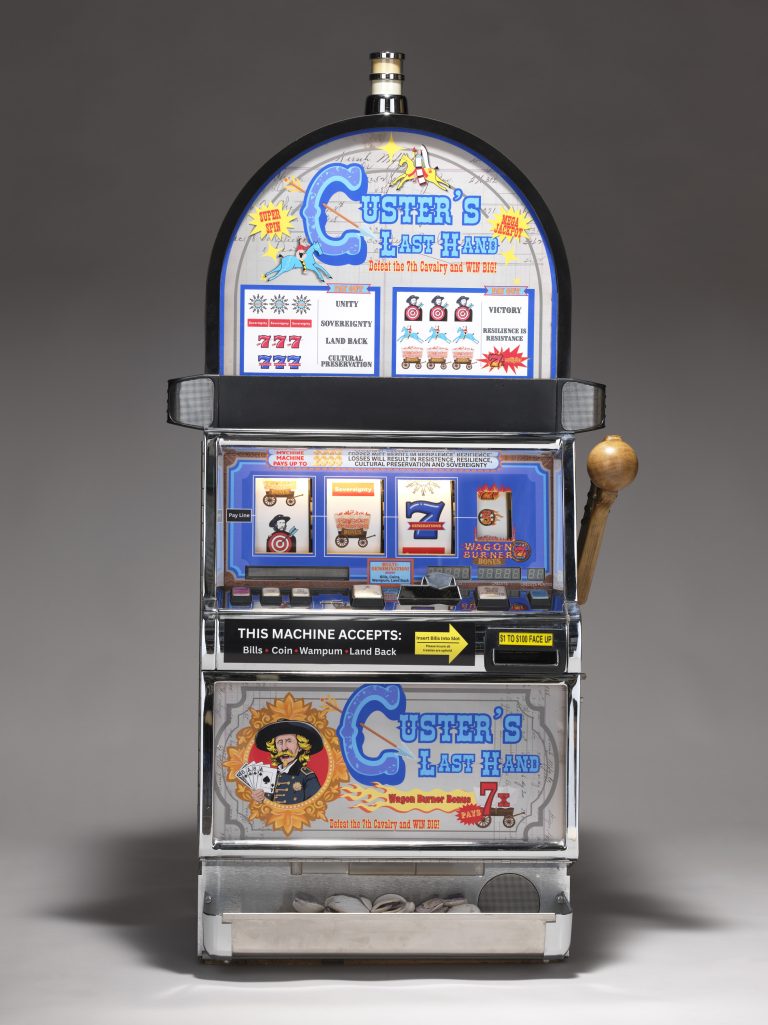
Tom Farris - "Custer's Last Hand" (2024): decommissioned and repurposed slot machine, Dimensions 53 × 26 × 20 inches (134.62 × 66.04 × 50.8 cm)

Tom Farris - "Custer's Last Hand" (2024): decommissioned and repurposed slot machine, Dimensions 53 × 26 × 20 inches (134.62 × 66.04 × 50.8 cm)

2024
Andy Everson - "Northern Warrior" (2015): acrylic-painted Star Wars stormtrooper helmet replica (unclear origin), with painted maple wood conical hat

Andy Everson - "Northern Warrior" (2015): acrylic-painted Star Wars stormtrooper helmet replica (unclear origin), with painted maple wood conical hat

Jonathan Thunder - "Quarantine at Gramma's House" (2020): acrylic on canvas

Jonathan Thunder - "Quarantine at Gramma's House" (2020): acrylic on canvas

Jefferey Veregge - "Of Gods and Heroes" (2018): made in Adobe Illustrator, part of a print on two 50 ft murals

Jefferey Veregge - "Of Gods and Heroes" (2018): made in Adobe Illustrator, part of a print on two 50 ft murals

Immersive Experience

Walk through this gallery in 3D

Step inside a virtual gallery space. Walk up to each artwork. See them as they were meant to be seen.

Experience in 3D

React to this gallery

Guestbook

Sign in to leave a comment.

Loading…